
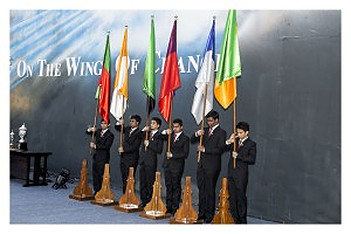
The House system is a feature common to public schools. At Cottons it traces back to the “Pu-chi teams” of around 1910 - six teams of 125 boys named Jerrimangalams, Bloodsuckers, Scorpions, White Ants, Mosquitoes and Cobras.
In 1933 these were re-formed into Houses honouring the pioneers who shaped the School’s character and traditions. A fourth House was added in 1956, and a fifth in 1996, reflecting the growth of the institution across its first century and beyond. Today every boy belongs to one of five Houses, each carrying the name of a man who gave distinguished service to Bishop Cotton Boys’ School. Through the year the Houses compete on the field, on the stage and in the classroom, fostering the spirit of endeavour and fair play that has always distinguished a Cottonian.
Named for the pioneers
Pettigrew
Named after Rev. S. T. Pettigrew, Chaplain of St. Mark’s Cathedral and founder of the School. Formed from the Scorpions and the Cobras, Pettigrew House embodies the founding spirit of faith and endeavour on which Bishop Cotton Boys’ School was built.
Pope
Named after Rev. George Uglow Pope, the first Warden of the School, 1871–1882. Formed from the White Ants and the Jerrimangalams, Pope House honours a scholar and churchman whose influence on the early School was formative and enduring.
Pakenham-Walsh
Named after the Rt. Rev. Herbert Pakenham-Walsh, Warden and author of the School Song. Formed from the Bloodsuckers and the Mosquitoes, Pakenham-Walsh House carries forward a legacy of leadership, learning and devotion to the School’s values.
Elphick
Named after Rev. Canon Elphick, Warden 1930–1955, who came to the School from the Oxford Brotherhood in Calcutta. Elphick House reflects the qualities of steadfast service and pastoral care that defined his long stewardship of the institution.
Thomas
Formed in memory of Rev. Iowerth Lewis Thomas, Warden 1956–1970, and instituted by Dr. A. Ebenezer. Thomas House stands as a reminder that the Cottonian tradition of principled leadership and service extends across every generation.